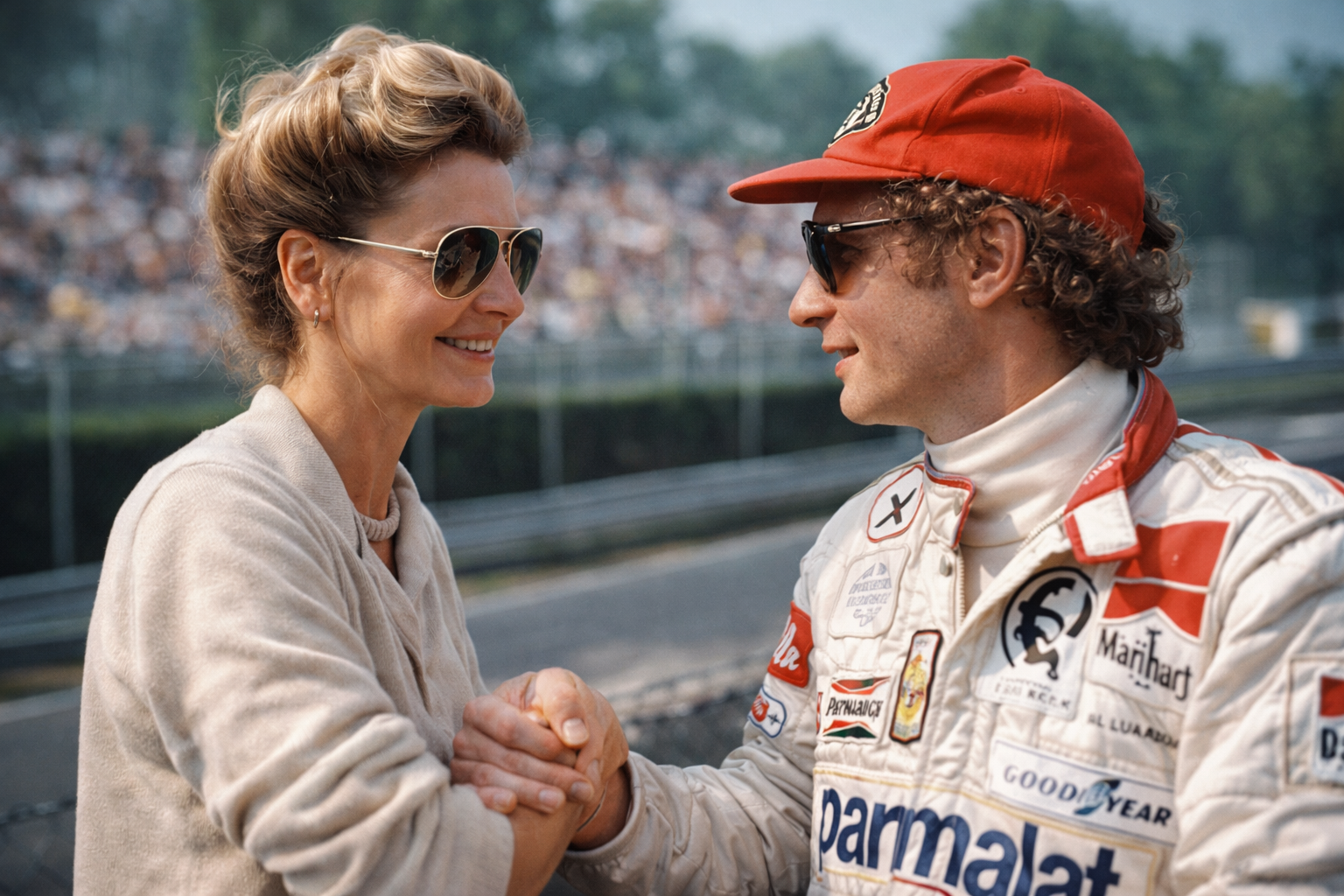
Marlene Knaus is one of those rare figures whose name continues to surface decades later, not because she sought attention, but because she stood close to a man who lived at the edge of danger and history. Best known as the first wife of legendary Formula One driver Niki Lauda, Marlene Knaus has long fascinated fans of motorsport and popular culture alike. Her story is not one of celebrity self-promotion, interviews, or memoirs. Instead, it is a quieter biography shaped by privacy, resilience, and the unseen emotional labor that often accompanies extraordinary public lives.
In an age where visibility is currency, Knaus represents something increasingly rare: a life intentionally lived away from the spotlight, even when the spotlight followed her relentlessly. Understanding her biography means understanding not only who she was, but also why she chose not to become something else.
Early life and background
Very little verified information exists about Marlene Knaus’s early life, and that absence is important. Unlike many public figures connected to sports or entertainment, she never cultivated a public origin story. Reputable sources generally agree that she was born in the early 1950s and spent part of her early life in Europe, but details such as her exact birthplace or upbringing remain unconfirmed.
What is clearer is the social environment she moved in as a young woman. By the early 1970s, Knaus was already connected to European high society and the international jet-set that surrounded motorsport, cinema, and elite business circles. This background placed her in proximity to Formula One long before she became part of its most dramatic chapter.
Her discretion even in later years suggests that this was not accidental silence but a deeply held personal value. From the beginning, Marlene Knaus appeared to understand that a life could be meaningful without being publicly documented.
Meeting Niki Lauda and entering the Formula One world
Marlene Knaus met Niki Lauda during the period when his career was rapidly accelerating. Formula One in the mid-1970s was not only a sport but a lifestyle defined by constant travel, risk, and intense public scrutiny. Drivers were becoming global celebrities, and their personal lives were increasingly treated as extensions of the spectacle.
Their relationship developed quickly, and they married in 1976. That year would become one of the most pivotal in Formula One history, and it would permanently bind Knaus’s name to Lauda’s legacy.
As Lauda rose to the top of the sport, Knaus found herself living inside a world where weekends could mean champagne celebrations or emergency hospital rooms. While Lauda became known for his analytical mind and ruthless honesty, Knaus was often described by contemporaries as composed and reserved, someone who brought calm into an environment defined by extremes.
Marriage during Formula One’s most dangerous era
The 1970s are often remembered as Formula One’s most perilous decade. Safety standards were inconsistent, fatalities were frequent, and drivers accepted risks that would be unthinkable today. Marlene Knaus became a wife in this environment, where the possibility of loss was never abstract.
Her role during this period is rarely documented in detail, but its significance is widely understood. Partners of drivers carried a psychological burden that remained invisible to fans. Every race weekend brought the knowledge that survival was not guaranteed. For Knaus, this reality became painfully real in 1976.
That year, during the German Grand Prix at the Nürburgring, Niki Lauda suffered one of the most horrific accidents in motorsport history. His car burst into flames after a high-speed crash, and he sustained severe burns along with lung damage from toxic fumes. For days, his survival was uncertain.
The Nürburgring crash and its personal aftermath
The Nürburgring crash is often framed as a story of heroic comeback, and rightly so. Lauda returned to racing just six weeks later, a feat that remains almost unbelievable. Yet behind that narrative was a private human crisis that profoundly shaped Marlene Knaus’s life.
During Lauda’s hospitalization and recovery, Knaus was confronted with the possibility of widowhood at a young age. Accounts from those close to the situation suggest that she was deeply shaken by the accident, not only by the injuries themselves but by what they revealed about the cost of the sport.
Although Lauda’s return to racing became legendary, the emotional impact on his family is less frequently discussed. For Knaus, the crash marked a turning point. It highlighted the tension between personal safety and professional obsession, a tension that would continue to influence their marriage.
Motherhood and family life
Marlene Knaus and Niki Lauda had two sons, Mathias and Lukas. Their upbringing took place against the backdrop of a father who was both globally famous and frequently absent due to racing and later business ventures.
Their eldest son, Mathias Lauda, followed in his father’s footsteps and pursued a career in motorsport. This decision inevitably reintroduced the family to the same risks that had defined Lauda’s career. For Knaus, watching her son enter racing likely carried emotional weight shaped by past trauma.
Despite this, she remained largely outside the public discussion of her children’s lives. Unlike many spouses of famous athletes, she did not leverage her family’s name to build a public platform. Her identity remained rooted in her role as a mother rather than as a public figure.
Divorce and life after Niki Lauda
After fifteen years of marriage, Marlene Knaus and Niki Lauda divorced in 1991. The separation received media attention primarily because of Lauda’s fame, but details about the reasons behind the divorce were not publicly dissected in the way celebrity splits often are today.
What is known is that the divorce marked Knaus’s final withdrawal from public life. While Lauda went on to remarry and remained a prominent figure in aviation and Formula One management, Knaus chose a path defined by privacy.
She did not grant interviews, write memoirs, or attempt to redefine her public image. In many ways, her post-divorce life reinforced the impression that her earlier visibility had been situational rather than aspirational.
Representation in popular culture
Interest in Marlene Knaus surged again in 2013 with the release of the film Rush, which dramatized the rivalry between Niki Lauda and James Hunt. The film portrayed Knaus as a stabilizing emotional presence in Lauda’s life, particularly during his recovery from the Nürburgring crash.
While the portrayal introduced her to a new generation, it also simplified her role, as films often must. The real Marlene Knaus was more complex than any screenplay could capture. Still, the film played a major role in renewing public curiosity about her, leading many viewers to search for the woman behind the character.
This renewed attention highlights a broader trend in modern storytelling. As sports narratives become more cinematic, the people surrounding athletes are re-examined through contemporary lenses, even when they never sought that attention themselves.
Privacy as a defining choice
What ultimately distinguishes Marlene Knaus from many figures associated with global fame is her consistent refusal to capitalize on it. She did not become a socialite brand, a media personality, or a public commentator on her former husband’s legacy.
In the digital era, where even distant associations can be transformed into influencer careers, her silence stands out. It suggests a deliberate philosophy: that personal experiences, especially painful ones, do not require public validation to be meaningful.
This choice has shaped how history remembers her. She exists in the public imagination not as a loud voice but as a quiet constant, someone whose influence is inferred rather than documented.
Legacy and modern relevance
Today, Marlene Knaus is often discussed in the context of Formula One history, gender roles in elite sports, and the emotional cost of high-risk professions. She represents the countless individuals who support extraordinary achievements without receiving recognition or applause.
As Formula One has grown into a global entertainment phenomenon, with unprecedented media exposure and storytelling, figures like Knaus serve as reminders of an earlier era. That era was rawer, less managed, and more dangerous, both physically and emotionally.
Her biography resonates precisely because it resists neat conclusions. She was present at defining moments, yet she refused to let those moments define her entire identity.
Conclusion
Marlene Knaus’s life cannot be measured by headlines, interviews, or social media metrics. Her biography is instead a study in restraint, strength, and the power of choosing privacy in a world that rarely respects it. As the first wife of Niki Lauda, she stood at the intersection of love, fear, and history during one of Formula One’s most dangerous periods.
Yet her lasting significance lies not in proximity to fame, but in her refusal to be consumed by it. In telling her story, we are reminded that some of the most important lives connected to public greatness are lived quietly, with dignity, far from the applause.